




OT asset context is what separates an inventory from an insight. Your discovery tool found the device. Good. Now answer the harder question. What does it do for the plant?
A server, a switch, a PLC. Each may have an IP address, vendor, and firmware version. None of those facts tell you what happens when it fails, or when an attacker owns it. The operational role of assets does. This article shows how to capture it, and why it improves every security decision that follows.
Discovery Tells You What Exists. Context Tells You What Matters.
Discovery produces attributes for your OT asset inventory. Make, model, MAC address, operating system, firmware. These are necessary. They are also identical across plants that run very different processes.
Recent joint guidance from CISA, CISA asset inventory guidance published in August 2025, and international partners emphasizes this distinction and pairs the inventory with an OT taxonomy.
The taxonomy classifies assets by function, criticality, or both, and maps their relationships and dependencies. It also treats an inventory as a foundation for defensible architecture, not a finish line.
Passive discovery can show what communicates on the network without introducing unnecessary operational risk. It cannot tell you which product the pump feeds, or how long the plant can run without it. That knowledge lives with engineers and operators.
Attributes describe the box. An OT asset taxonomy describes the job the box does.
Five Questions That Define an Asset’s Operational Role
-
Which process does it support?
Name the unit, line, or product. “Compressor controller” is a type. “Gas export compressor train 2” is a role.
-
What happens if it fails or is compromised?
This defines OT asset criticality. Think in three outcomes: loss of view, loss of control, loss of safety. Add production, environmental, and regulatory impact. Note the manual fallback and how long operators can sustain it.
-
What does it depend on, and what depends on it?
Shared services, upstream feeds, downstream consumers. Dependence reveals the blast radius.
-
Where does it sit?
Record the Purdue level, the zone, and the conduits it crosses. Position tells you how reachable it is and what it can reach.
-
Who owns it?
Name the operational owner and the approver for changes. Ownership converts a finding into an action.
How Operational Role Improves Every Security Decision
Context pays off across the program:
- Vulnerability prioritization: the same CVE ranks differently on a safety-related controller than on a reporting server.
- Patch planning: role shows whether to patch now, wait for a planned window, or apply compensating control.
- Segmentation: dependencies show which conduits are essential and which can be closed.
- Incident response: responders see the blast radius before they isolate anything.
- Audit readiness: evidence maps to the assets that matter most under NCA OTCC and similar frameworks.
The business outcome is simple. Fewer unplanned outages. Faster decisions. You can defend the audits.
A Worked Example: Two Identical Servers, Two Different Priorities
This scenario is for illustrative purposes. Two Windows servers share the same operating system, patch level, and open vulnerability.
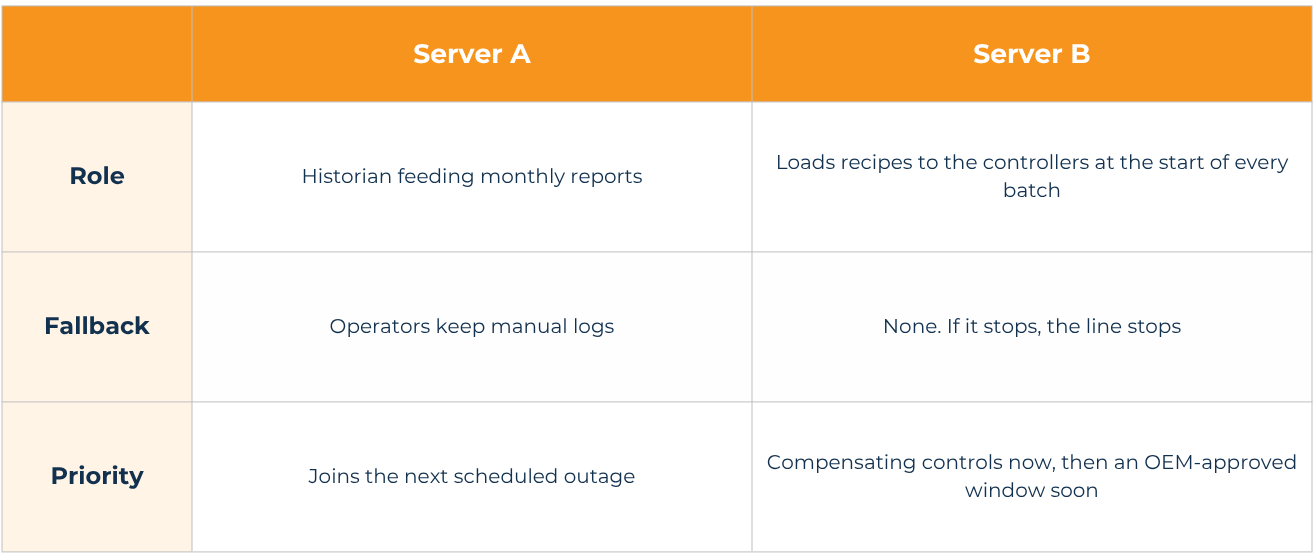
- A severity-sorted list treats them the same. An operational view does not. Server B gets compensating controls now and an OEM-approved window soon. Server A joins the next scheduled outage. The vulnerability did not change. The context did. That is the difference between a patch list and a risk-based plan.
Build Operational Context Without Disrupting the Plant
The joint guidance outlines six steps. Here is how they translate to the plant floor:
- Define scope: start with your most critical processes, not the whole site.
- Identify assets: use passive discovery. Avoid active scanning or probing of live controllers unless it is explicitly approved, tested, and safe for the operational environment.
- Collect attributes: add role, owner, and fallback to technical fields.
- Create a taxonomy: drive OT asset classification by function and criticality, with operations in the room.
- Manage data: keep one source of truth, with clear update ownership.
- Manage the life cycle: update records at commissioning, change, and retirement.
Start small. Pick the ten processes that would hurt most if they stopped. Enrich those assets first, then expand.
One expert habit helps most. Ask the engineers. Networks reveal devices. People reveal purpose.
Standards agree on the direction. ISA/IEC 62443 uses zones and conduits to structure security requirements, with security levels informed by risk. NIST SP 800-82 Rev. 3 stresses that OT security must respect safety and availability.
How OTNexus Turns Inventory Into Operational Context
OTNexus Asset Management organizes assets by Company, Site, Plant, Cabinet, and Asset. It supports classification, criticality, connectivity mapping, and baseline configuration tracking. Unlimited custom parameters let you record the process supported, the owner, and the manual fallback.
That context then feeds Risk Management, Vulnerability Management, Network Segmentation, and Compliance. Each decision starts from the asset’s role. See how this supports an OT Security Management Centre.
Frequently Asked Questions
What is OT asset context?
It is the operational meaning of an asset: what it does, how critical it is, what it depends on, and who owns it.
What is an OT asset taxonomy?
An OT asset taxonomy is a classification system that organizes assets by function, criticality, relationships, and dependencies to support risk identification, vulnerability management, and incident response.
How is OT asset criticality determined?
Criticality reflects the potential consequence of an asset’s failure or compromise across safety, production, environmental, regulatory, and business-continuity impacts. Operations, engineering, and security teams should define it together.
Conclusion
An asset list tells you what you have. Operational context tells you what to protect first.
See how OTNexus brings asset inventory, criticality, ownership, and dependencies into one governed view.