





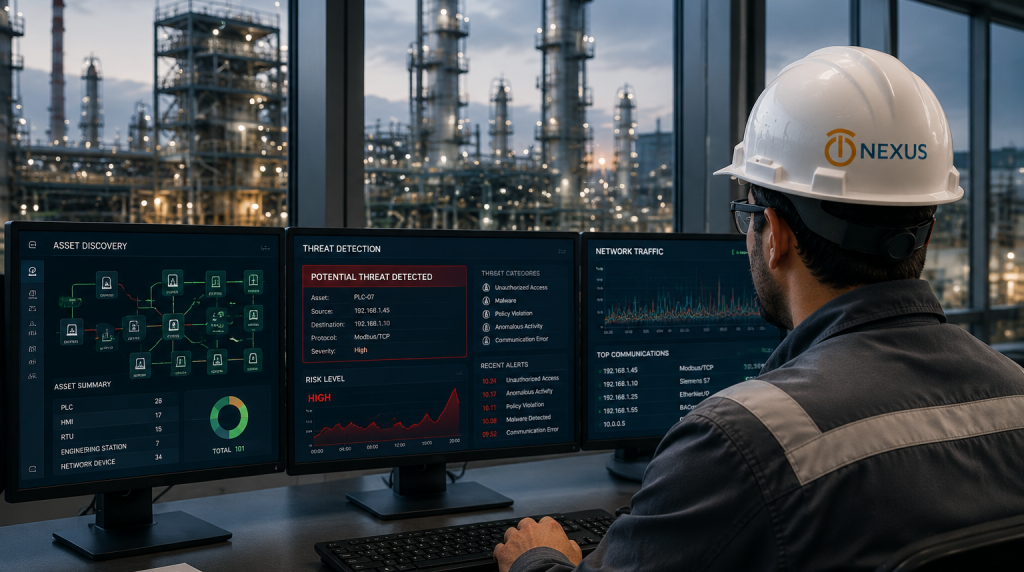
OT threat detection is one of the most misunderstood disciplines in industrial cybersecurity and one of the most consequential to get wrong.
In 2025, Dragos tracked 119 ransomware groups impacting more than 3,300 industrial organizations worldwide, nearly double the number from the previous year.
In 30 percent of incident response cases, investigations began not with a detection alert, but with someone noticing that something seemed wrong in operations. The telemetry needed to determine whether an attacker was involved had never been collected.
The implication is direct that most industrial organizations are not detecting OT threats.
They are discovering them after:
- The damage is done
- Production has stopped
- A safety system has been bypassed
This guide explains what OT threat detection actually is, how it works in ICS and SCADA environments, how to assess your current detection capabilities, what the role of AI is in modern detection program, and critically how to choose a trusted OT threat detection and response provider that is genuinely aligned to your industry and operational environment.
What Is OT Threat Detection?
OT threat detection is the continuous process of identifying malicious, anomalous, or unauthorized activity within operational technology environments including industrial control systems, SCADA platforms, PLCs, HMIs, RTUs, and the industrial networks that connect them.
The distinction from IT threat detection is not semantic.
It is structural.
IT threat detection focuses primarily on data confidentiality, identifying when data is being:
- Extracted
- Encrypted
- Manipulated
OT threat detection focuses on operational integrity and physical safety, identifying:
- When control logic is being manipulated.
- When set points are being altered.
- When safety systems are being bypassed.
- When an attacker is pre-positioning inside a control network for future disruption.
According to the TXOne Networks 2026 Annual OT/ICS Cybersecurity Report, 96 percent of OT security incidents originate from IT-level compromises, and 60 percent of organizations experienced OT incidents in 2025.
The path from a corporate network phishing email to a manipulated PLC in a refinery is well documented and it is the path that effective OT threat detection must cover entirely, not just at the OT boundary.
How OT Threat Detection Works in ICS, SCADA, and Industrial Control Systems
Passive Network Monitoring – The Foundation
Unlike IT environments where active scanning is standard, real-time threat detection in OT ICS SCADA environments must begin with passive monitoring.
Active scanning – sending probe packets across the network to discover and interrogate devices can crash legacy PLCs, trigger false alarms in safety systems and interrupt live industrial processes.
A passive monitoring approach captures and analyses network traffic without generating any of its own, building a complete picture of the OT environment from what it observes.
Passive monitoring in OT must also be protocol-aware.
Industrial networks communicate using protocols such as:
- Modbus
- DNP3
- PROFINET
- EtherNet/IP
- OPC-UA
These protocols contain the commands that control industrial processes.
A monitoring solution that only understands TCP/IP traffic is effectively blind to most OT communications.
Behavioral Baselining and Anomaly Detection
Once the network is passively monitored, effective OT threat detection establishes a behavioral baseline to determine:
- What normal communication looks like
- Which devices communicate with each other
- How often communication occurs
- What commands are expected
A PLC that normally exchanges 200 packets per minute with a specific HMI does not suddenly send 2,000 packets without reason.
A SCADA server that communicates only with local field devices should not suddenly initiate outbound communication with an external IP address.
These deviations from established behavior become indicators of potential compromise.
According to Dragos’s 2026 OT Threat Landscape analysis, threat groups such as AZURITE operate inside engineering environments collecting configuration and operational data for extended periods without directly interacting with industrial environments in ways that trigger traditional alerts.
Only behavioral baselining – detecting that something is operating differently from its established norm – can identify this type of pre-positioned attacker.
The ICS Cyber Kill Chain
Effective OT threat detection and response track attacker progression through the ICS Cyber Kill Chain.
This model is designed specifically for industrial environments and maps adversary activity from:
- Initial investigation
- Initial access
- Network discovery
- Lateral movement
- Engineering system compromise
- Physical process manipulation
The SANS 2025 State of OT Security survey found that while 49 percent of organizations report having OT-specific detection capabilities, only 12.6 percent report full visibility across the ICS Cyber Kill Chain.
At Level 1 — PLCs and RTUs where physical process manipulation occurs — visibility remains significantly weaker.
This visibility gap is where attacks succeed.
Attackers who reach Level 1 without triggering detection can:
- Modify control logic
- Alter operational setpoints
- Disable safety instrumented systems
All while the organization believes it is monitoring the environment.
Assessing Your Current OT Threat Detection Capabilities
Before choosing a provider or investing in additional detection capabilities, a governance and compliance manager or OT security lead must understand where current detection coverage ends.
The following questions define the assessment framework:
- Can you see every OT asset in your environment, including devices at Purdue Model Level 1 and Level 2 in real time?
If not, your detection coverage has structural blind spots. - Does your monitoring solution understand OT-native protocols Modbus, DNP3, PROFINET, OPC-UA at the command level?
A solution that sees only IP traffic cannot detect malicious commands issued through industrial protocols. - Do you have a documented behavioral baseline for your OT network?
Without knowing what normal looks like, anomaly detection becomes guesswork. - How long would it take to detect lateral movement from an IT network into your OT environment?
In 30% of Dragos’s 2025 incident response cases, intrusions were discovered operationally, not through detection tools. - Is your detection coverage integrated with your asset inventory?
A vulnerability disclosed for a specific firmware version is only actionable if you know which assets are running that version. - Can you demonstrate continuous monitoring evidence to an auditor, not just proof that a monitoring tool exists, but logs showing what was detected and how it was investigated?
In 30 percent of incident response cases in 2025, investigations began not with a detection alert, but with someone noticing that something seemed wrong in operations. The telemetry required to determine whether adversary activity was involved had never been collected.
Proactive OT Threat Detection: Moving from Reactive to Predictive
Most OT threat detection programs in industrial organizations today are reactive.
They identify threats after indicators of compromise have appeared in the network.
Proactive threat detection moves the detection window earlier in the attack lifecycle before the attacker has achieved their objective.
Proactive detection in OT operates across three dimensions:
Threat Intelligence Integration
Industry-specific threat intelligence allows organizations to understand:
- Which threat actor groups are targeting their sector
- What tactics and techniques those groups are using
- Which OT device types and protocols are being exploited
This intelligence enables detection rules and monitoring priorities to be established before an attack campaign reaches the environment.
The Shieldworkz 2026 OT Threat Landscape Report documents more than 60 threat actors with fully mapped TTPs.
This type of intelligence separates proactive detection from reactive alert management because organizations are able to prepare detection capabilities before attackers begin targeting their environment.
Vulnerability Management as a Detection Input
A newly published CVE affecting a specific PLC firmware version is not only a patching task, it is also a detection priority.
Proactive OT threat detection integrates vulnerability intelligence with the asset inventory to identify:
- Which assets are exposed
- Which systems require increased monitoring
- Which devices represent higher operational risk
This creates a direct relationship between asset visibility, vulnerability management and threat detection.
The difference is significant:
Reactive security asks:
“Have we already been compromised?”
Proactive security asks:
“Which assets are most likely to be targeted, and how do we detect early warning signs?”
The Asset Management capability within OTNexus helps connect asset information with security monitoring, allowing organizations to prioritize detection based on their actual industrial environment.
Behavioral Drift Monitoring
Industrial processes are highly repetitive by design.
When the behavior of a device or process gradually changes, it may indicate:
- A developing operational issue
- Configuration drift
- An attacker testing the environment
- Early-stage malicious activity
Proactive real-time threat detection in OT ICS SCADA environments tracks these behavioral changes over time.
Unlike traditional security monitoring that waits for known malicious signatures, behavioral drift monitoring identifies subtle deviations from established patterns.
Examples include:
- PLC communicating with a previously unknown device.
- Workstation accessing systems outside its normal operating pattern.
- Control command being issued at an unusual time.
- Device communicating using unexpected protocols.
These small deviations may appear harmless individually but become significant when analyzed together.
The Role of AI in OT Threat Detection: Real Benefits and Honest Limitations
Artificial intelligence is genuinely transforming OT threat detection capabilities, but it is also frequently overpromised by vendors.
Understanding what AI does well in OT environments and where its limitations exist is essential when evaluating detection solutions.
What AI Does Well in OT Threat Detection
The core value of AI in OT threat detection is:
Scale and pattern recognition.
Large industrial facilities generate thousands of device communications every minute across multiple protocols.
Human security teams cannot manually analyze this volume of information.
Machine learning models trained on OT-specific data can:
- Establish behavioral baselines across thousands of devices simultaneously
- Detect subtle deviations invisible to traditional rule-based systems
- Reduce alert fatigue by filtering operational noise
- Correlate activity across multiple systems and timeframes
AI-powered OT threat detection and response is especially valuable for identifying attackers who are already inside the network and behaving normally.
These attackers may not trigger traditional alerts because they are using legitimate accounts, approved tools, and normal communication channels.
Their presence appears as a pattern of small deviations:
- Slight changes in communication behavior
- Unusual access patterns
- Unexpected interactions between systems
AI can correlate these signals at a scale that would not be possible manually.
OTNexus AI Capability
The OTNexus AI-Nexus module applies AI capability specifically to OT governance and compliance by:
- Predicting compliance gaps before audits identify them
- Prioritizing vulnerability remediation based on operational impact
- Providing governance intelligence
- Improving the effectiveness of the OT Security Management Centre (SMC)
The objective is not simply generating more alerts.
The objective is creating better operational decisions from security data.
What AI Cannot Replace in OT Detection
AI-generated detection alerts in OT environments must remain advisory, not autonomous.
Unlike traditional IT environments, where automated responses such as isolating a device or blocking communication may be acceptable, OT environments control physical processes where an incorrect automated action can create operational disruption or safety risks.
For example:
- Automatically blocking communication between a PLC and HMI may stop the production process
- Disconnecting a safety-critical device may create unsafe operating conditions
- Quarantining an engineering workstation during an active process may impact plant availability
SANS ICS has explicitly recommended against fully autonomous AI response in OT environments because a false positive can itself become an operational incident.
Human review of AI recommendations is not a weakness.
It is the correct design principle for environments where security actions can have physical consequences.
The role of AI in OT should therefore be:
- Identify patterns
- Prioritize risks
- Provide recommendations
- Support human decision-making
Not:
- Automatically interrupt industrial operations without validation
How to Choose a Trusted OT Threat Detection Service
The managed OT threat detection and response vendor market has expanded rapidly.
However, many providers entering this space are traditional IT security companies that have added OT capabilities to their portfolio without having the operational expertise required for industrial environments.
Choosing the wrong provider can create dangerous detection gaps while giving organizations a false sense of security.
A trusted OT threat detection provider must demonstrate the following capabilities:
-
Passive-First Architecture
Any vendor whose detection solution requires:
- Active scanning
- Agent installation on OT endpoints
- Network configuration changes that could disrupt live processes
should be evaluated carefully.
Legitimate OT threat detection is passive by design.
The provider should be able to explain how the solution monitors the environment without interfering with industrial operations.
A genuine OT-native solution should:
- Observe network traffic
- Understand industrial protocols
- Build behavioral baselines
- Detect anomalies without modifying the environment
If the vendor cannot explain how monitoring occurs safely, the solution may not be designed specifically for OT.
-
Protocol-Level Intelligence
A trusted provider must understand industrial protocols at the command level, not just at the packet level.
Important OT protocols include:
- Modbus
- DNP3
- PROFINET
- EtherNet/IP
- OPC-UA
- IEC 61850
The key question is:
Does the solution understand what commands are being executed inside these protocols?
A system that only detects unusual network traffic but cannot interpret industrial commands has limited visibility.
For example:
A generic network monitoring tool may identify communication between two devices.
An OT-native detection platform should understand whether:
- A PLC received an unexpected command
- A setpoint was modified
- A control instruction deviated from normal behavior
- A device accessed an unusual industrial function
Protocol awareness is what separates general network monitoring from true OT threat detection.
-
Industry-Specific Experience
A trusted industry-aligned OT threat detection provider must demonstrate experience within the customer’s specific sector.
Industrial environments are not interchangeable.
The operational requirements of, Oil and gas facilities, Power generation plants, Pharmaceutical manufacturing, Water utilities, and Heavy manufacturing are fundamentally different.
A provider must understand:
- Process constraints
- Safety requirements
- Operational availability requirements
- Regulatory obligations
For example:
For Gulf energy operators in Saudi Arabia and the UAE, the provider must understand:
- NCA OTCC requirements
- DESC ICS requirements
- IEC 62443 expectations
For pharmaceutical manufacturers, the provider must understand:
- GMP constraints
- Validation requirements
- Restrictions around system modifications
Industry alignment is not a marketing advantage.
It is a prerequisite for effective OT threat detection.
-
Integration with Governance and Compliance
Detection without governance integration becomes noise management.
Every detected threat, anomaly, and investigation should contribute to the wider cybersecurity management program.
Detection events should support:
- Risk register updates
- Compliance evidence
- Audit documentation
- Security decision-making
A detection solution that produces alerts without connecting those alerts to:
- Risk management
- Asset visibility
- Compliance documentation
is solving only part of the problem.
Effective OT cybersecurity requires connecting detection with governance.
The purpose of detection is not simply identifying problems.
The purpose is enabling organizations to understand:
- What happened
- Why it matters
- Which assets are affected
- What action is required
-
Transparent Detection Methodology
A provider should clearly explain:
- How behavioral baselines are created
- How anomalies are identified
- What triggers alerts
- How false positives are reduced
- How detection logic can be tuned
A detection system that operates as a complete black box creates challenges:
- Security teams cannot validate decisions
- Analysts cannot tune detection accuracy
- Operations teams cannot trust alerts
A credible OT threat detection and response provider should be able to explain:
- Why an alert was generated
- What behavior was unusual
- How serious the risk is
- What investigation steps should follow
Transparency creates trust.
How Industry-Aligned OT Threat Detection Providers Secure the OT Environment
The difference between a generic security vendor and an industry-aligned OT threat detection provider is not simply the sophistication of the technology.
The difference is the operational context that shapes how technology is:
- Deployed
- Tuned
- Integrated
- Used during real incidents
An industry-aligned provider understands that every industrial environment has different:
- Processes
- Risk levels
- Regulatory obligations
- Safety requirements
- Operational priorities
A detection platform that works well in one environment cannot simply be transferred to another without understanding the specific operational context.
An industry-aligned provider brings three capabilities that generic vendors cannot:
Context-Aware Baseline Tuning
Industrial environments have unique operating patterns.
A chemical plant, power generation facility, and pharmaceutical manufacturing line all have different normal behaviors.
An industry-aligned provider understands:
- Which communication patterns are expected
- Which process changes are operationally normal
- Which deviations represent genuine risk
This allows detection systems to be calibrated according to the actual environment rather than relying on generic industrial assumptions.
Without proper context, detection platforms may generate:
- Excessive false positives
- Alert fatigue
- Missed threats hidden among operational noise
Context-aware tuning ensures security teams focus on events that genuinely matter.
Sector-Specific Threat Intelligence
Different industries face different threat landscapes.
An effective OT threat detection program requires understanding:
- Which threat actor groups target the industry
- Which tactics and techniques they use
- Which OT technologies they commonly exploit
- Which indicators suggest attacker presence
Sector-specific intelligence allows organizations to prepare detection capabilities before attackers reach their environment.
For example:
- Energy organizations may face threats targeting SCADA and control systems
- Manufacturing organizations may face ransomware campaigns targeting production environments
- Critical infrastructure operators may face nation-state campaigns focused on disruption
Threat intelligence transforms detection from a reactive capability into a proactive security function.
Regulatory Alignment
Detection evidence must support the regulatory requirements applicable to the organization.
An industry-aligned provider understands that different sectors and regions require different compliance approaches.
Examples include NCA OTCC, IEC 62443, NERC CIP, NIS2 and DESC ICS.
Detection logs, investigation records, and response documentation must be maintained in a format that supports audit and governance requirements.
Generic compliance reporting is often insufficient because industrial regulators require evidence specific to operational environments.
OTNexus: Connecting OT Threat Detection with Governance
OTNexus connects OT threat detection with the wider cybersecurity governance program through the OT Security Management Centre (SMC).
This ensures that:
- Every detection event contributes to the risk register
- Every investigation creates audit evidence
- Every anomaly is evaluated against the organization’s asset inventory
- Every security decision considers the compliance posture
This integration transforms threat detection from a monitoring function into a governance capability.
Traditional monitoring solutions often stop at:
“An alert has been generated.”
A mature OT cybersecurity management approach continues further:
- Why did this happen?
- Which asset is affected?
- How critical is that asset?
- What compliance impact exists?
- What action should be taken?
By connecting detection, asset visibility, risk management, and compliance, organizations gain a complete operational security picture.
Conclusion: Detection Without Governance Is Noise Management
Effective OT threat detection is not a product. It is a program. A mature OT detection capability combines passive protocol-aware monitoring, AI-powered anomaly detection, proactive threat intelligence, behavioral analysis and governance integration.
Detection alone does not create security.
A platform that generates thousands of alerts without helping organizations understand risk, prioritize actions, and maintain compliance simply creates more noise.
The organization’s that successfully detected threats before they became operational incidents shared common characteristics:
- They had complete asset visibility
- They maintained accurate behavioral baselines
- They used industry-specific threat intelligence
- They treated every detection event as governance evidence, not just another security ticket
Choosing a trusted OT threat detection service begins with asking whether a provider can demonstrate all of these capabilities within your:
- Industry environment
- Regulatory context
- Operational requirements
If they cannot, then the detection coverage they provide, regardless of how advanced the technology appears, may still leave the gaps attackers are already exploiting. Technology alone does not secure industrial environments. The combination of visibility, context, intelligence and governance creates effective OT cybersecurity.
Is Your OT Environment Actually Detecting Threats or Just Monitoring?
Book a 20-minute walkthrough of OTNexus, including AI-Nexus threat intelligence, Passive anomaly detection, Governance integration, and Audit-ready detection evidence. The walkthrough is tailored to your Industry, Regulatory framework, and OT environment.